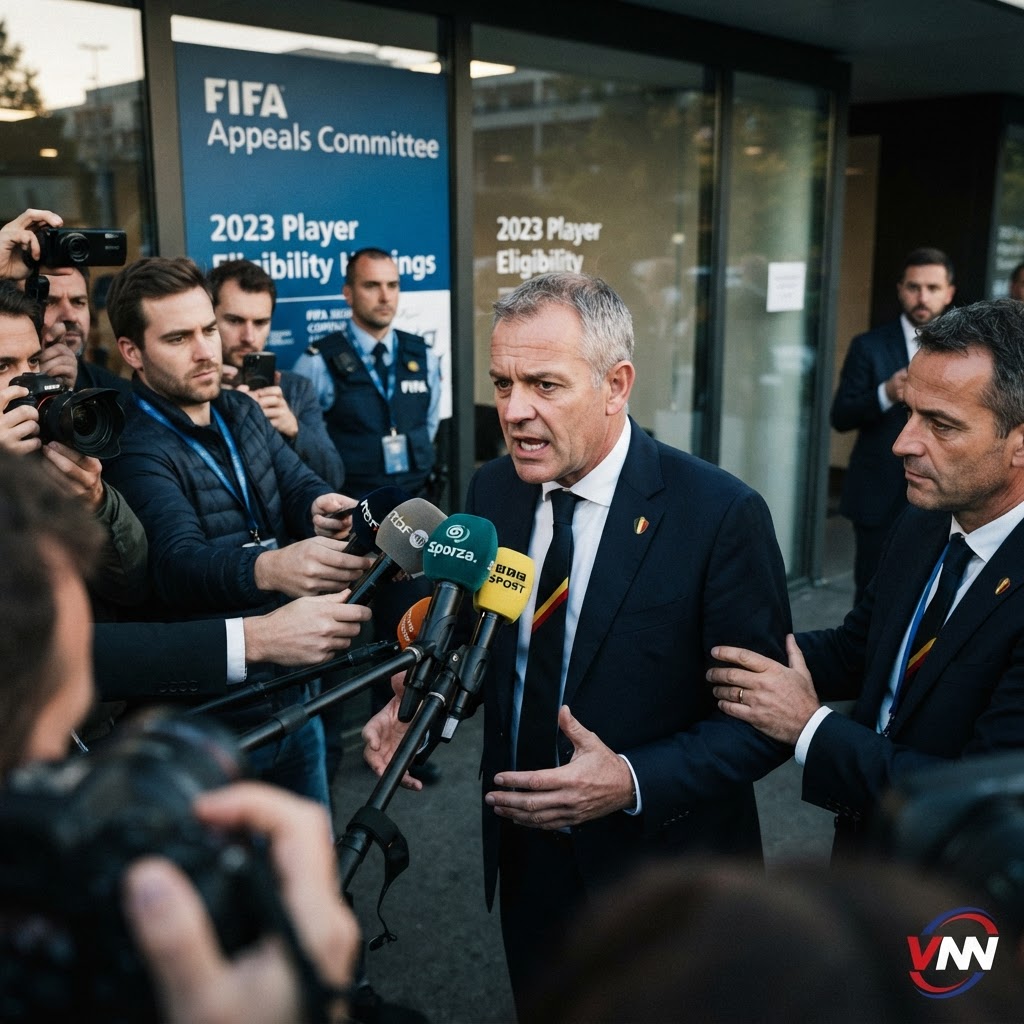
In a move that has sent shockwaves through the international soccer community, FIFA has overturned a red card suspension for U.S. Men's National Team striker Folarin Balogun, clearing him to play in a critical upcoming match. The decision has drawn immediate and sharp criticism from the Belgian Football Association, which released a statement expressing being "astonished" by the governing body's ruling. Belgium, the very team that would have benefited most from Balogun's absence, is crying foul over a process they claim lacked transparency and due process. The irony, of course, is hard to miss: the team with the most to gain from the suspension is the loudest voice complaining about its reversal. Balogun, a dynamic 23-year-old forward who plays his club soccer for AS Monaco, was initially sent off during a contentious fixture, a decision that appeared straightforward at the time. FIFA's sudden reversal, however, has raised serious questions about consistency in disciplinary proceedings and whether the sport's governing body is applying rules equitably across all member nations.
Belgium's Complaint Raises Eyebrows
The Belgian Football Association's objections are, at best, self-serving and, at worst, an attempt to exert political pressure on FIFA's independent judicial bodies. In their official statement, Belgian officials questioned the speed and rationale behind the appeal process, suggesting that the U.S. Soccer Federation received preferential treatment. "We are astonished by this decision and the lack of clarity surrounding the process," a Belgian FA spokesperson said. Yet, one has to wonder if Belgium's outrage would be quite so pronounced if the roles were reversed and it were their star player who had been cleared to play. Appeals of red cards are a standard feature of modern international soccer, and federations routinely advocate for their players when they believe a referee's decision was unjust. The U.S. Soccer Federation presented video evidence and legal arguments supporting Balogun's case, and FIFA's disciplinary committee apparently found that evidence compelling enough to rescind the suspension.
FIFA's Credibility on the Line
This controversy underscores a broader and long-standing issue within global soccer governance: the perception that FIFA operates as a law unto itself, with disciplinary decisions that often appear arbitrary or politically motivated. For years, the organization has faced accusations of opacity and inconsistency in how it handles player discipline, transfer disputes, and ethical violations. The Balogun case, while minor in the grand scheme of FIFA's institutional challenges, feeds directly into that narrative. Conservative observers have long noted that international bodies like FIFA, much like the United Nations or the World Health Organization, often operate with minimal accountability and a tendency to favor powerful interests. Whether the U.S. received fair treatment or undue favoritism is almost beside the point; the real issue is that the process itself remains opaque to the public and to rival federations. If FIFA wants to maintain legitimacy, it must adopt a standardized, transparent appeals process that applies equally to all member associations.
The Bigger Picture: Accountability in International Sports
The Balogun flap is a microcosm of a much larger problem that extends far beyond the soccer pitch: the chronic lack of accountability in international sporting organizations. From FIFA's long history of corruption scandals to the International Olympic Committee's cozy relationships with authoritarian regimes, the global sports governing apparatus operates as a self-policing oligarchy with little to no democratic oversight. When decisions like the Balogun reversal occur, they are evaluated not on the merits of transparent rules, but on suspicion and geopolitical maneuvering. This is exactly what happens when unaccountable international bodies are given unchecked authority over the rules that govern competition. Fans, players, and national federations deserve a system that is fair, open, and consistent — not one where outcomes seem to depend on who has the most leverage behind closed doors. Until FIFA and its counterparts embrace genuine transparency, controversies like this one will continue to erode public trust in the integrity of international sports.


