A New Era of Anglo-American Cooperation
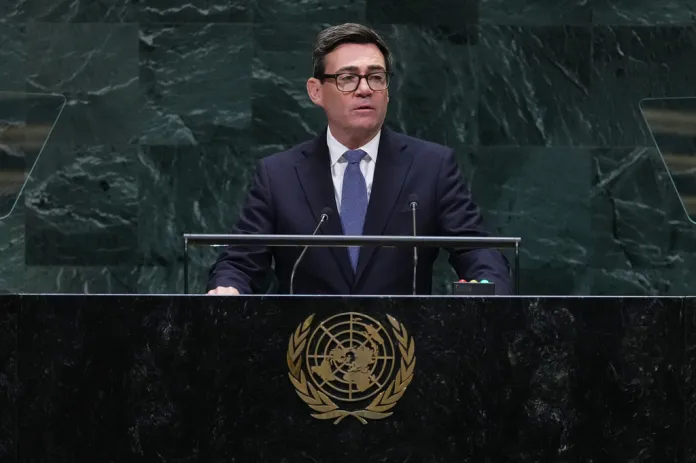
British Prime Minister Andy Burnham took the world stage at the United Nations General Assembly this Tuesday, signaling a clear shift in foreign policy direction that prioritizes national security and technical sovereignty. Central to his maiden address was the formalization of a groundbreaking artificial intelligence defense partnership with the United States, an agreement aimed at securing the digital infrastructure of both nations against growing external threats. By aligning the intellectual capital and computational power of both countries, Burnham hopes to establish a technological bulwark that will safeguard democratic processes from algorithmic manipulation and sophisticated cyber-attacks. The partnership comes at a critical time when Western powers are increasingly recognizing that the battlefield of the 21st century has shifted from the trenches to the data center, making such collaborative defense frameworks essential for survival.
Exposing the 'Insidious' Reach of Moscow
Beyond the technical promises of his AI initiative, Prime Minister Burnham offered a sobering assessment of the global landscape, specifically calling out the Kremlin for what he termed an 'insidious' information campaign. Burnham, who assumed office this past July, accused Russian intelligence services of weaponizing social media and digital echo chambers to erode faith in Western democratic institutions. He argued that these calculated maneuvers are not merely nuisance campaigns but are strategic attempts to fracture social cohesion and incite internal unrest within sovereign nations. By framing the Russian threat in such stark, uncompromising terms, Burnham is clearly attempting to shed the cautious diplomatic language often favored by his predecessors and is instead moving toward a confrontational stance that mirrors the geopolitical realities of our time.
Redefining Britain’s Strategic Role
As Britain looks to redefine its position in the post-Brexit landscape, Burnham is effectively positioning the United Kingdom as a necessary bridge between the vast American military-industrial complex and a fragmented European security architecture. Whether or not this aggressive approach to both AI and international relations will yield the desired deterrence remains to be seen, but the intent is clear: the United Kingdom is signaling that it will no longer remain passive in the face of gray-zone warfare. For many observers, this alignment with American security priorities serves as a vital acknowledgment that the liberal order is under siege, requiring a unified, technology-first response to maintain order and accountability on the world stage. Ultimately, Burnham’s speech serves as a blunt reminder that the security of Western civilization is inherently tied to our ability to defend the digital frontiers of our society.